WHA79 High-level Side Event on Protecting SRHR Amid Global Funding Pressures
Start Date: 20 May 2026
End Date: 20 May 2026
Location: Geneva, Switzerland
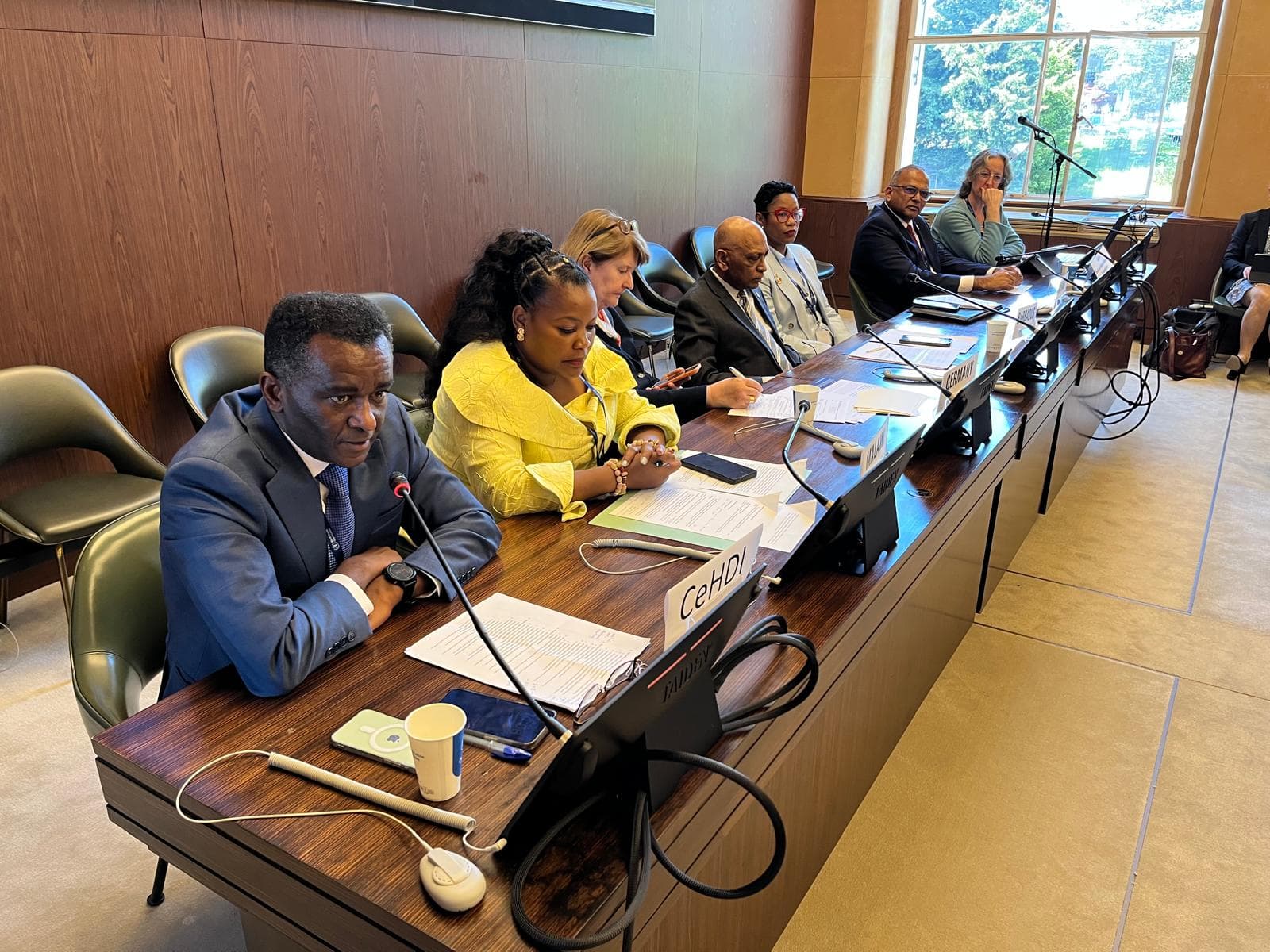
At the 79th World Health Assembly (WHA79), the Global Center for Health Diplomacy and Inclusion (CeHDI), alongside the Permanent Missions of Guyana, Malawi, Barbados, and Germany and the UNPFA, co-hosted a high-level official side event entitled “Sexual and Reproductive Health and Rights: Preserving Essential Services Amid Funding Pressures.”
Notably, this was the only official side event focused on sexual and reproductive health and rights (SRHR) – a reflection of the shrinking global attention to an agenda that remains central to health equity, universal health coverage and gender equality.
A Critical Moment for Sexual and Reproductive Health and Rights
Opening the session, H.E. Ambassador Leslie Ramsammy of Guyana set the tone by highlighting the severity of the current global funding crisis and its consequences. He pointed to the sharp decline in international commitments, noting that global SRHR funding has been cut by half and that key agencies such as UNFPA are being defunded. Other global data mentioned further underscore this trend: in 2023, only 23% of donors allocated more than 5% of their health ODA to SRHR, while EU funding for SRHR fell below 0.71% of total health ODA.
These funding cuts are already having measurable consequences. As emphasized during the session, they are linked to a sharp increase in unintended pregnancies and preventable maternal deaths, reflecting the tangible human cost of political and financial decisions.
Ambassador Ramsammy stressed the centrality of SRHR to global health systems, stating:
“Universal health coverage cannot be achieved without equitable access to comprehensive SRHR services.”
He framed the central question for the panel: how to sustain political will, financing, and accountability in a context of increasing resistance, competing priorities, and shrinking resources.
National Leadership in the Face of Global Pushback
Speakers highlighted that, while global support may be declining, national leadership and policy commitment remain critical.
The Minister of Health of Barbados, Senator the Hon. Lisa Cummins, presented a strong example of a country maintaining a progressive and resilient SRHR framework. Barbados continues to provide free SRHR services through its primary healthcare system, supported by partnerships with civil society and long-standing investments in family planning.
Reflecting on this sustained commitment despite current global constraints, the Minister emphasized that Barbados remains steadfast in its approach:
“Barbados at all times prioritizes our national objectives and values... We believe in the protection of rights for women and girls. We believe in the preservation of those rights that have been established under the UN system… SRHR is Barbados’ priority in the past, today, and tomorrow.”
The Donor Community Must not Treat SRHR as an “Add-on”
From a donor perspective, Germany reaffirmed its leadership in supporting women’s health globally. H.E Ambassador Antje Leendertse underscored the need for renewed commitment and prioritization of SRHR, emphasizing that several elements are essential: increased awareness, strengthened partnerships, and clearly defined investment targets from donor communities dedicated to women’s health.
She further stressed: “SRHR should not be treated as an add-on.”
Persistent Barriers in Low-resource Settings
The Minister of Health of Malawi, Hon. Minister Madalitso Baloyi,offered an important perspective from a country facing structural and financial constraints. While Malawi has made progress in expanding access to family planning and reproductive health services, major barriers remain to address the high maternal mortality rate in the country.
She emphasized the realities on the ground, noting that economic hardship, geographic barriers – including long distances to access health services – and weak health information systems continue to limit access, particularly for rural populations.
The Minister also highlighted the importance of domestic resource mobilization and system reform, including ringfencing budgets, improving efficiency, and empowering primary healthcare facilities. These measures are essential to sustaining services in the absence of reliable external funding.
Despite these challenges, the Minister reaffirmed the government’s commitment to SRHR, stating:
“We recognize that sexual and reproductive health is a human right… and we take this issue seriously.”
Accelerating Impact through Targeted Investments
The Minister of Health of Guyana, Hon. Dr. Frank Anthony, underscored how evidence-based interventions have driven rapid improvements in maternal and neonatal outcomes in recent years. By expanding access to free healthcare, introducing maternal waiting homes in remote areas, and strengthening emergency obstetric care, Guyana has achieved significant reductions in maternal deaths, including zero deaths in some regions. These efforts are reinforced by ongoing investments in workforce development and digital health solutions to extend care to underserved communities.
The Minister concluded: “We feel that we can do better, and with the type of investments that we're making, we hopefully will see more profound changes…we are continuously working to reduce maternal mortality”
Investing in SRHR is a “Best Buy”
UNFPA’s Director of Programme Division, Julia Bunting, reinforced the economic and social case for investing in SRHR, particularly in an environment of declining development assistance. Drawing on evidence, she highlighted that investments in family planning and midwifery deliver significant returns, not only in health outcomes but also in broader socioeconomic benefits.
She noted that: “Investing in SRHR is not only the right thing to do… it is one of the best buys in health.”
Strengthening Accountability and Political Commitment
CeHDI’s CEO Dr. Haileyesus Getahun highlighted that international human rights frameworks already position right to health, including SRHR, as a government obligation, underscoring the importance of accountability mechanisms, such as the Universal Periodic Review (UPR).
Dr. Getahun also highlighted evidence showing that countries that received greater UPR engagement on maternal health demonstrated significantly faster reductions in maternal mortality: “This highlights that engagement with the UPR is critically important and counters the critique that discussing the right to health in the Human Rights Council is merely a talk show. The process is particularly significant as it is often managed by the highest political bodies in a country, such as the Cabinet, the Minister of Foreign Affairs, or the Minister of Justice.”
A Shared Call to Action
Across all speakers, a consistent message emerged: SRHR must remain a global priority despite funding pressures and political resistance. The discussion also highlighted the need to counter growing ideological pushback and to ensure that women’s rights, bodily autonomy, and access to care remain protected.
In closing, Ambassador Ramsammy delivered a powerful message:
“We should never have a World Health Assembly where SRHR is not a prominent issue until we end preventable maternal deaths.”