OACPS Builds Momentum for Advancing Health Equity
Start Date: 16 May 2026
End Date: 16 May 2026
Location: Geneva, Switzerland
A platform for South–South collaboration and influencing the global health architecture
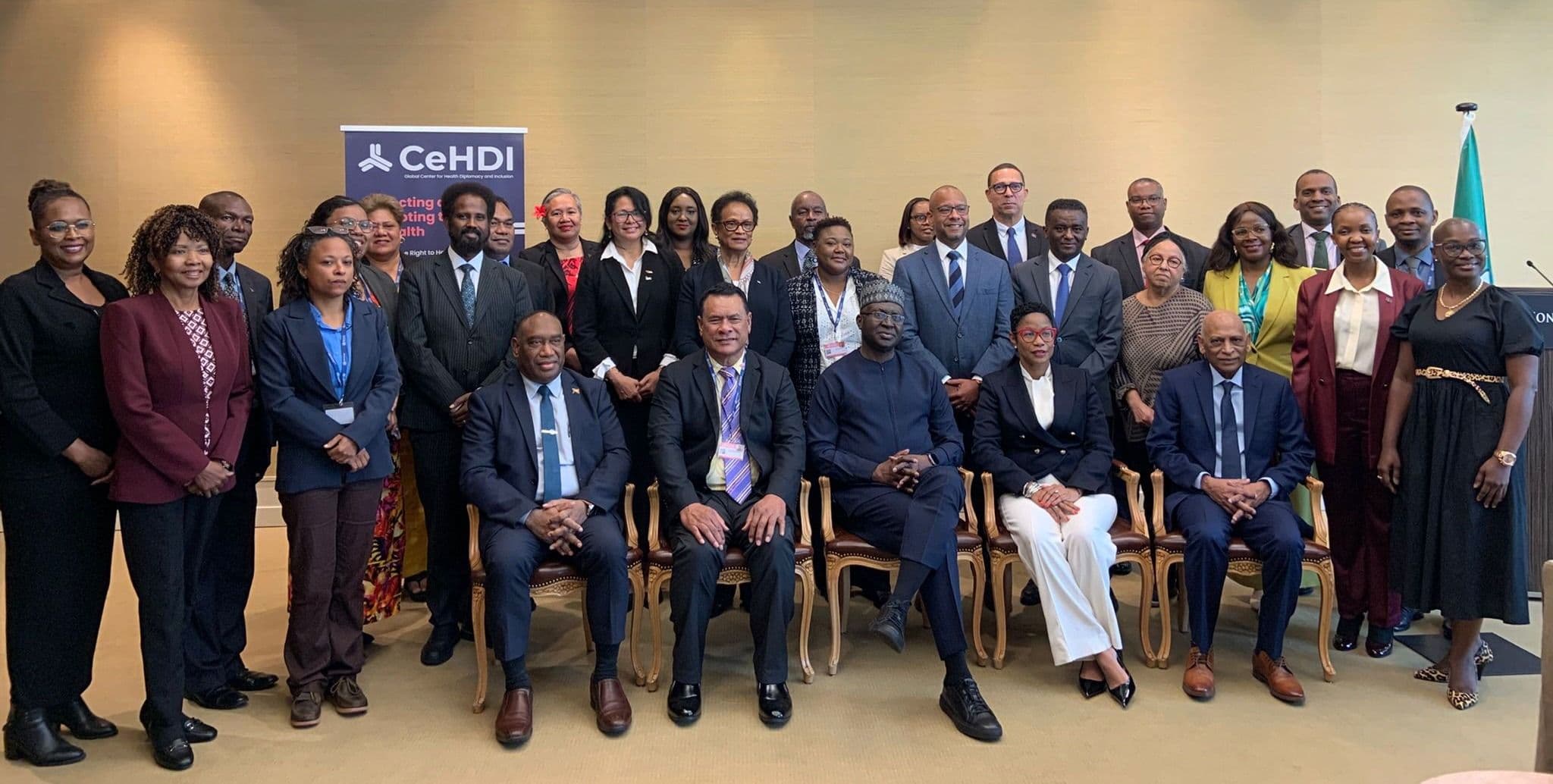
In the margins of the 79th World Health Assembly (WHA) which is being held in Geneva on May 18th to 22nd, 2026, Ministers and Ambassadors from the Organisation of African, Caribbean and Pacific States (OACPS) convened on Saturday May 16th for a high-level meeting aimed at strengthening coordination and amplifying the collective voice of the Global South in global health governance.This high-level meeting was organised by the Permanent Mission of Guyana, the OACPS, and CeHDI, with Ambassador Dr. Leslie Ramsammy of Guyana serving as coordinator.
The meeting built on growing OACPS engagement in Geneva’s multilateral ecosystem — extending coordination efforts beyond the World Trade Organization (WTO) to UN-based agencies such as World Health Organisation (WHO) and the Human Rights Council — and highlighted the potential for a more unified approach across these spaces. It follows the Malabo Declaration of the 11th OACPS Summit (March 2026), which recognized South–South cooperation as central to advancing health.
A key message was that OACPS is not only a political grouping, but a platform for collaboration, enabling countries from Africa, the Caribbean, and the Pacific to share national experiences, align priorities, and strengthen their collective influence for health equity through global health diplomacy. Representing 1.5 billion people, the bloc was recognized as having both the legitimacy and strategic weight to help shape global health priorities.
As emphasized by Ambassador Prof. Muhammadou Kah, speaking on behalf of the OACPS Secretary General:
“The Malabo Declaration reaffirmed that health remains central to sustainable development, human dignity, and resilience across our member states.”
This ambition was echoed by the Honourable Minister of Health V.S. Alofipo of Samoa, speaking on behalf of the Pacific:
“Together, Africa, the Caribbean and the Pacific represent more than 1.5 billion people. When our voices are aligned, we can help shape a more equitable global health architecture, one in which our countries are not merely participants, but active architects of the decisions that affect our own people.”
Multilateralism under strain and the role of OACPS
A strong and recurring theme throughout the meeting was the growing strain on multilateralism in today’s geopolitical context. Speakers highlighted mounting pressures on the global health system, including increasingly uncertain financing and declining trust in global governance mechanisms.
In this context, the OACPS was positioned as a critical force for revitalizing multilateral cooperation by ensuring that global health governance remains inclusive, equitable, and responsive to the needs of developing countries. As Honourable Minister of Health and Wellness of Barbados, Lisa Cummins, noted:
“These are troubling times for multilateral cooperation and health diplomacy. That is why I am pleased to celebrate a group of countries from three very distinct regions, who have historically collaborated and are governed by the shared vision of togetherness is better than going alone. Global health demands global partnerships, and this is what we're trying to do through the OACPS’ renewed agenda on health issues and health diplomacy.”
Participants emphasized that collective action is no longer optional but essential. The COVID-19 pandemic exposed profound inequities in vaccine access and technology transfer, while also demonstrating the value of coordinated global responses driven by solidarity.
There was broad recognition that without stronger coordination, the Global South risks continued marginalization in key negotiations, including those related to the Pandemic Agreement and Pathogen Access and Benefit Sharing (PABS). In response, participants called for stronger alignment of OACPS’ positions across Geneva processes, closer coordination with other diplomatic hubs, and more proactive engagement in shaping reforms of the global health architecture.
Overall, the OACPS was presented as a bridge across regions and a stabilizing force in a fragmented system, with the potential to advance more equitable outcomes while reinforcing trust in multilateral cooperation.
A shared agenda for health equity and resilience
Across regions, speakers converged around a set of core technical priorities reflecting shared challenges and opportunities for collective action. A central concern was the shortage and migration of health workers, with many countries facing significant “brain drain” to higher-income settings. This imbalance is particularly stark in Africa, which bears nearly 25% of the global disease burden but has only around 3% of the global health workforce. Participants called for greater investment in training, stronger regional partnerships, and a shift from extractive recruitment practices to co-investment models.
As highlighted by Honourable Minister Elias Kapavore of Papua New Guinea: “Health workforce development and system resilience cannot be addressed in isolation.”
There was also strong emphasis on building resilient health systems capable of withstanding future shocks, including pandemics and climate-related crises. This includes strengthening preparedness, advancing universal health coverage, and ensuring equitable access to vaccines, diagnostics, and treatments. Climate change was recognized as an accelerating health threat, particularly for the vulnerable Small Island Developing States (SIDS), further reinforcing the need to integrate climate resilience into health systems.
Maternal, child, and reproductive health remained a priority area, with concern that progress is slowing or being reversed. Participants stressed the urgency of addressing maternal mortality, safeguarding access to sexual and reproductive health services, and accelerating efforts to eliminate cervical cancer.
Ambassador Dr. Leslie Ramsammy from Guyana captured the urgency of these inequities:
“OACPS must ensure, not long from now, that a mother giving birth anywhere in the world has the same chance of safely delivering her baby, and that the baby has the same chance of living to be five years old and becoming an adult.”
Speakers also highlighted the persistent gap in technology transfer, which remains an unfulfilled commitment despite its importance for building local manufacturing capacity and strengthening pharmaceutical resilience. At the same time, digital health and artificial intelligence were identified as critical opportunities to expand access, improve service delivery, and overcome resource constraints, provided that equitable access and enabling regulatory frameworks are in place.
As noted by Ambassador Dr. Richard Brown of Jamaica: “Digital transformation and AI will be critical to overcoming the constraints our health systems face.”
Finally, non-communicable diseases, including cancer, were identified as a growing burden across regions, underscoring the need for stronger prevention, early detection, and action on modifiable risk factors.
Conclusion: towards a stronger, unified OACPS presence in Geneva
The OACPS meeting highlighted a clear strategic direction: in a context of strained multilateralism, stronger coordination and collective leadership are essential to ensure more equitable global health outcomes.
Concluding remarks from Ambassador Dr. Leslie Ramsammy from Guyana:
“We should all have the same right to health…We must ensure that global leaders and policymakers understand that health is wealth, that without health, there is no productivity… And therefore, investment in health isn't goodwill. Investment in health is in fact development overall.”
The overarching message was both simple and powerful: health equity will not be achieved without a strong, coordinated voice from the Global South, and OACPS is uniquely placed to lead this effort.
The Centre for Health Diplomacy and Inclusion (CeHDI) was recognized by several speakers for its instrumental role in supporting coordination efforts and strengthening the OACPS health agenda in Geneva.