Ambassadorial Dialogue Examines Ways to Accelerate Cervical Cancer Elimination
Start Date: 17 November 2026
End Date: 17 November 2026
Location: Geneva, Switzerland
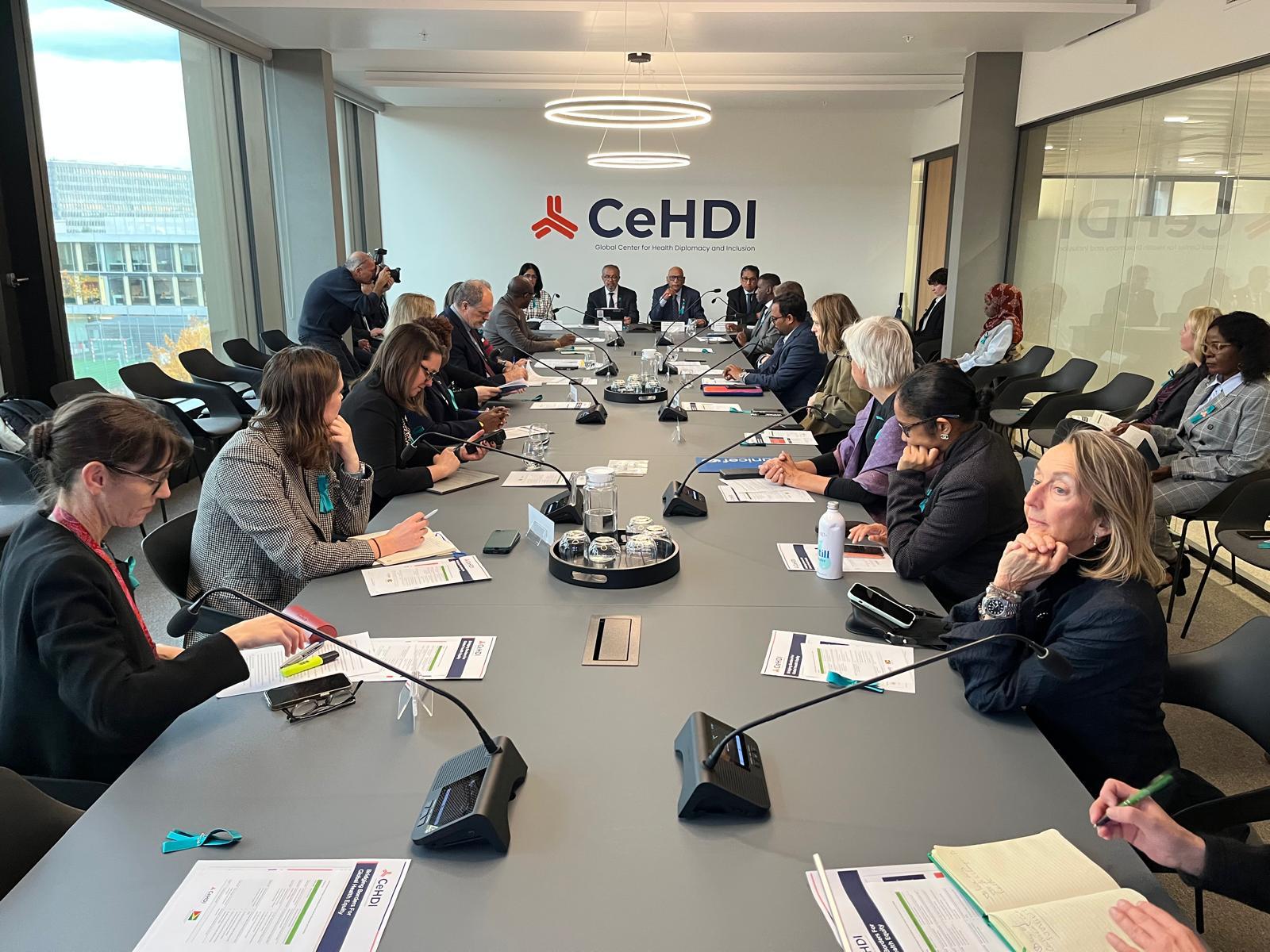
The Global Centre for Health Diplomacy and Inclusion (CeHDI) and the Permanent Mission of Guyana to the United Nations in Geneva convened an ambassadorial dialogue in Geneva on 17 November 2026, World Cervical Cancer Elimination Day. Held in line with the global theme, “Together We Can Eliminate Cervical Cancer,” the dialogue highlighted the importance of addressing the equity gap, collaboration and collective action to accelerate progress towards eliminating cervical cancer as a public health problem.
Ambassadors, international agencies, health experts and civil society representatives examined global progress toward cervical cancer elimination, national implementation challenges, and opportunities to accelerate vaccination, screening and treatment, especially in low- and middle-income countries. The discussion also considered whether establishing a global target date could help accelerate cervical cancer elimination. WHO Director-General Dr Tedros Adhanom Ghebreyesus suggested bringing together experts to examine progress across countries and assess the feasibility of setting such a date.
Global progress and the 2030 targets
Opening the dialogue, Dr Leslie Ramsammy, Permanent Representative of Guyana in Geneva, urged ambassadors to champion the right to health and help ensure that a largely preventable cancer no longer claims women’s lives because of where they live or their ability to obtain care.
Dr Haileyesus Getahun, CEO of CeHDI, noted that the WHO Global Strategy for the Elimination of Cervical Cancer projected elimination of cervical cancer as a public health problem by the year 2120. He drew lessons from the global HIV response, where ambitious treatment targets helped mobilize political leadership, resources and new delivery approaches. He argued that similar ambition, combined with effective national implementation and measurable indicators, could accelerate cervical cancer elimination.
Dr Tedros reviewed developments since WHO’s global call to action in 2018 and adoption of its elimination strategy in 2020. The strategy calls for 90% of girls to be fully vaccinated against human papillomavirus (HPV) by age 15, 70% of women to be screened with a high-performance test by age 35 and again by age 45, and 90% of women with cervical precancer or cancer to receive appropriate treatment by 2030.
Although 166 countries have introduced HPV vaccination and single-dose schedules have facilitated wider access, progress remains uneven. Globally, only 33% of girls were vaccinated against HPV in the previous year, while screening and treatment continue to lag. Cervical cancer causes an estimated 280,000 deaths annually, overwhelmingly in low- and middle-income countries.
Dr Tedros identified three priorities: replacing opportunistic screening with organized programmes that identify eligible women, provide regular testing and ensure timely follow-up and treatment; reaching girls missed by vaccination programmes and addressing misinformation; and financing cervical cancer elimination as part of national universal health coverage plans. He stressed that programmes must respect women’s dignity, privacy and right to make informed decisions, and address barriers arising from cost, distance, stigma, caregiving and limited decision-making autonomy. Women and girls, he said, should help shape the programmes intended to serve them. Dr Tedros also emphasized the need to sustain these efforts over the long term. “2030 is a milestone. Not the finish line. A girl vaccinated this year will need screening 20 years from now. The systems we build today must be there for her then.”
Country experiences and implementation challenges
Fabrice Safali Mihogo, First Secretary at Rwanda’s Permanent Mission in Geneva, reported that HPV vaccination coverage among adolescent girls has exceeded 90%, while screening coverage has reached approximately 30%. Its “Mission 2027” aims to achieve the WHO targets three years ahead of schedule. Affordable HPV DNA testing, expanded oncology services and health workforce capacity are priorities, supported by broad community-based health insurance coverage.
Margot Morris, Health Counsellor at Australia’s Permanent Mission in Geneva, described progress towards eliminating cervical cancer as a public health problem in her country by 2035, alongside continuing efforts to improve access for First Nations communities through culturally safe, community-led services. Australia is also supporting nine Pacific Island countries to strengthen cervical cancer prevention and care.
Anna-Mari WongHämäläinen, Charge d’Affairs of the Permanent Mission of Finland in Geneva, described more than six decades of HPV screening of her country, which have reduced cervical cancer incidence to about one-fifth of historical levels. She highlighted population-based screening, gender-neutral HPV vaccination and the integration of sexual and reproductive health services into primary care.
Ambassador Ramsammy reported on Guyana’s use of nonavalent HPV vaccines and free cervical screening, including government vouchers enabling women to obtain tests in private facilities at public expense.
Ambassador M Riaz Hamidullah of Bangladesh noted that HPV vaccination was introduced in 2023 and integrated into routine immunization in 2024. Between 2018 and 2023, 1.55 million women were screened. He also described the potential of low-cost diagnostic technologies in rural communities, while acknowledging persistent challenges involving stigma, awareness and access.
Ambassador Aashna Wandani Kanhai of Suriname described school-based vaccination and misinformation, including unfounded concerns about infertility. Despite improvements in testing capacity, screening remains largely opportunistic rather than part of an organized national programme.
Ambassador Ann-Kathryne Lassègue of Haiti highlighted severe limitations in diagnostic capacity and resulting underreporting, calling for stronger prevention, screening, early diagnosis, access to treatment and reliable health data.
Vicki Blackman, Health Attaché at Barbados’s Permanent Mission in Geneva, described the challenges of introducing HPV vaccination amid concerns about adolescent sexuality. Integrating vaccination for boys and girls into routine immunization has helped improve uptake in her country, although vaccine hesitancy during the COVID-19 pandemic created setbacks. She emphasized the need for sustained engagement with parents, communities and health workers.
Multilateral partnerships and technological innovation
Ambassador Anne-Claire Amprou, Chair of the Unitaid Executive Board, highlighted new region-wide HPV testing access agreements announced by the Pan American Health Organization (PAHO/WHO) on 11 November, with Unitaid support. The arrangements are expected to reduce test costs by 30% to 70% in participating countries in Latin America and the Caribbean. Unitaid also reported investing US$100 million in 26 countries since 2018 and emphasized the effectiveness of self-sampling and nurse-led treatment close to women’s homes. She concluded that “every country moving faster saves human life now”
Dr Richard Mihigo of Gavi reported that its HPV vaccination revitalization programme had reached 95 million girls by the end of 2025, exceeding its initial target of 86 million. Average HPV vaccination coverage in Gavi-supported countries rose from approximately 6% to 29%. Gavi is also expanding access to nonavalent HPV vaccines and testing ways to include HPV vaccination with adolescent health and primary health care services for more sustainable and integrated delivery.
Dr Ravivarman Lakshmanasamy of the International Agency for Research on Cancer (IARC) drew attention to HPV-35, which accounts for an estimated 1% to 2% of cervical cancers globally but 7% to 8% in African populations, with higher proportions in parts of Southern and Eastern Africa. Currently licensed HPV vaccines do not include this subtype, and evidence of cross-protection is inconclusive. IARC described work with WHO, Gavi and CeHDI on a technical roadmap for its possible inclusion in future vaccines, following discussions with manufacturers. The proposed vaccine development would help address a gap in protection affecting women in parts of Africa.
Dr Søren Brostrøm, Director of WHO’s Department of NCDs and Mental Health, outlined work on HPV DNA tests, self-sampling and emerging screening tools, including AI-assisted approaches.
Alison Cox of the NCD Alliance stressed that programs must reach women living with HIV and other underserved groups, and that people with lived experience should participate in programme design and accountability. Cervical cancer elimination, she argued, should help to strengthen cancer registries, pathology, referral systems, radiotherapy and the health workforce rather than create a separate programme. This, she added, would be a concrete test of Universal Health Coverage using integrated care pathways.
Alfonso Barragués, Deputy Chief of UNFPA’s Geneva Representation Office, similarly called for integrating cervical cancer services into sexual and reproductive health and primary care, including services for out-of-school girls, rural communities and people in humanitarian settings.
Towards a global elimination date
Participants in the dialogue considered whether the world should set a date for eliminating cervical cancer as a public health problem, defined as fewer than four new cases per 100,000 women per year. They acknowledged the political value of a shared deadline while recognizing that HPV infection can precede cancer by decades and that national vaccination, screening and treatment coverage varies widely.
Representatives of Haiti, Suriname, Bangladesh and Barbados described the implications of differing national circumstances, including limited awareness, social stigma and resistance to vaccination. Technical contributors suggested combining a long-term global goal with country-specific reductions in incidence and measures of equity and access, so that progress in lower-resource countries could be assessed against meaningful interim milestones.
Dr Tedros proposed bringing together a group of modelling experts to examine progress in early-adopting countries and countries in the Global South, including Rwanda. He suggested that the analysis could help to establish what is feasible and inform a realistic global elimination date.
In closing, Ambassador Ramsammy called for greater “interoperability” among WHO, Gavi, Unitaid, UNFPA, IARC, national governments and civil society, alongside sustained efforts to counter misinformation.
Suggested ways forward
- Accelerate implementation of the WHO 90-70-90 targets through adequately financed national programmes that link HPV vaccination, organized screening, diagnosis and treatment.
- Expand access to HPV testing, self-sampling, timely follow-up and cancer treatment, with greater investment in primary health care and underserved communities.
- Use pooled procurement and vaccine innovation to improve affordability and address gaps in protection, including those associated with HPV-35.
- Counter misinformation and strengthen community engagement to reach girls and women excluded from existing vaccination and screening services.
- Explore the feasibility of establishing a global cervical cancer elimination date through new expert modelling.
- Consider country-specific interim milestones and measures of equity to reflect differing national circumstances and track progress towards elimination.