High-Level Diplomatic Dialogue: Towards a Cervical Cancer-Free Future: The Final Push
Start Date: 13 March 2026
End Date: 13 March 2026
Location: Geneva, Switzerland
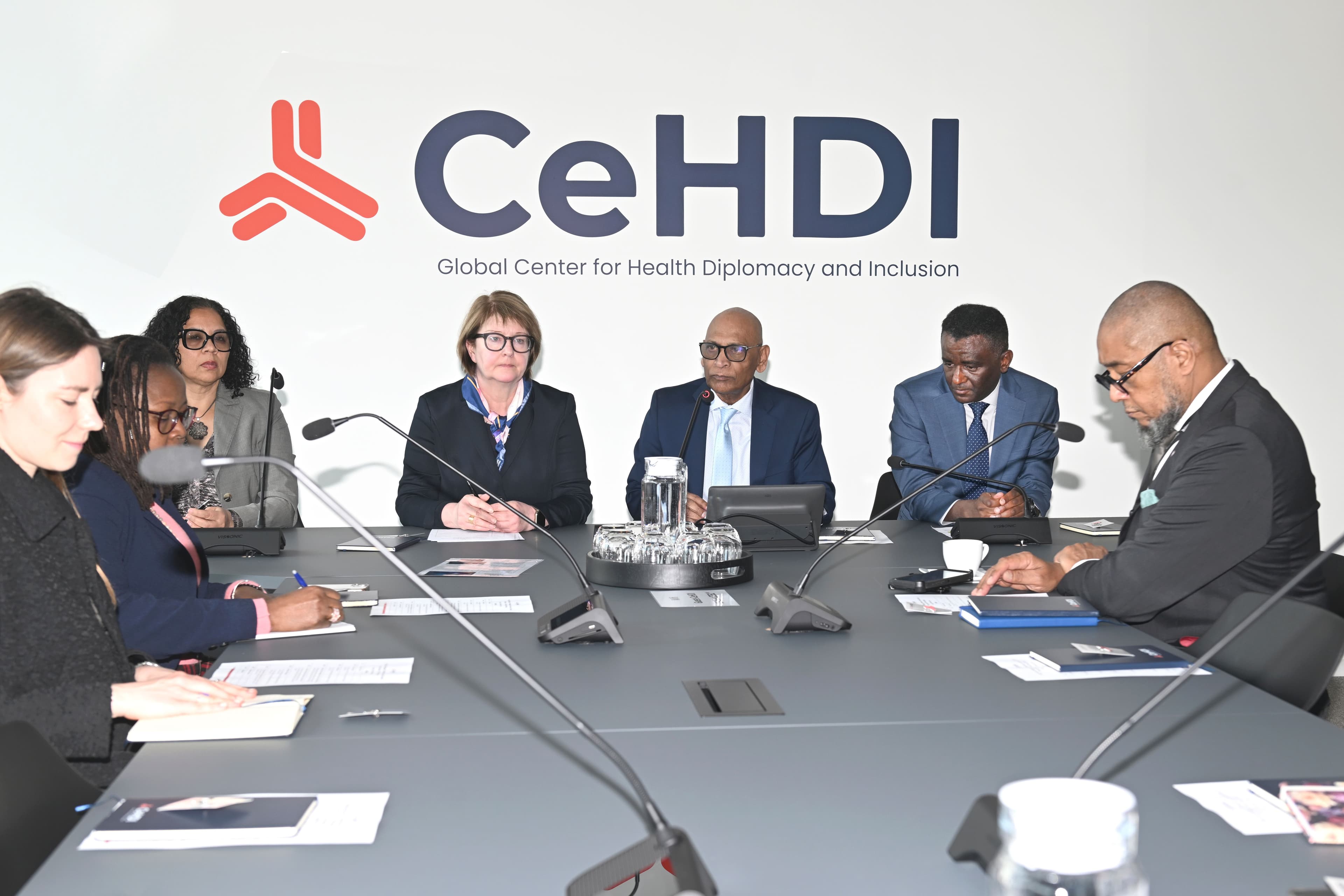
The Global Centre for Health Diplomacy and Inclusion (CeHDI) convened a high-level diplomatic dialogue on cervical cancer elimination, co-organized by the Permanent Missions of Barbados, Germany, Guyana and Malawi. The hybrid meeting was attended by ambassadors, diplomats, public health experts and multilateral partners. It was moderated by the Permanent Representative of Guyana to the UN in Geneva, H.E. Ambassador Dr Leslie Ramsammy who coordinates the Organisation of African, Caribbean and Pacific States on health matters.
Presenters and panelists discussed the global equity challenges of cervical cancer screening, diagnosis and treatment and highlighted efforts globally and in several countries towards its elimination. They emphasized that while cervical cancer is largely preventable through HPV vaccination, early screening and effective treatment, the disease continues to disproportionately affect women in low- and middle-income countries. Speakers stressed the importance of international cooperation, political leadership, and sustainable financing to achieve the “90-70-90” targets by 2030 set out in the WHO Global Strategy to Accelerate the Elimination of Cervical Cancer as a Public Health Problem.
Introductions
Welcome: CeHDI CEO Dr Haileyesus Getahun, welcomed participants and noted that addressing health equity in cervical cancer screening, diagnosis and treatment is a high priority in the context of CeHDI’s mission to advance the right to health. He emphasized the crucial role of health diplomacy in nurturing strong North-South and South-South cooperation among countries to advance the right to health and universal health coverage at a time when global solidarity and multilateralism are being eroded.
Moderator’s remarks: Opening the meeting, Ambassador Ramsammy noted that because cervical cancer is a preventable disease that disproportionately affects women in low- and middle-income countries, it reflects major global health and gender inequities. Around 600,000 cases and 340,000 deaths occur annually, 94 per cent of which occur in low‑ and middle‑income countries.He highlighted the importance of countries achieving the 90‑70‑90 targets in the WHO global strategy by 2030 if they are to be on the path to elimination: 90% HPV vaccination, 70% screening coverage, and 90% treatment of detected disease. He noted that most developed countries are positioned to achieve the elimination of cervical cancer by 2050 and that global elimination by around 2080 is possible if all countries intensify vaccination, screening, and treatment programs. Strong diplomatic leadership, increased political commitment, and strengthening of North–South and South–South collaboration are critical to accelerate elimination timelines in low- and middle-income countries. Ambassador Ramsammy also encouraged learning from the global HIV response.
Presentation
Dr Natalie Broutet of the University of Sydney, Australia presented an overview of cervical cancer and the drivers of its inequity globally. She stressed that although cervical cancer is one of the few cancers that can be prevented and treated with early detection, it continues to disproportionately kill women in low- and middle-income countries.The four key drivers of this inequity - which need to be addressed simultaneously - are: 1) HPV vaccination gaps due to cost, misinformation and delivery challenges; 2) inadequate screening due to lack of access to HPV testing, limited laboratory capacity and workforce shortages; 3) lack of treatment capacity, including radiotherapy equipment; and 4) social determinants, including poverty, gender norms and education. Dr Broutet highlighted that vaccination coverage is low outside the Americas, and emphasized the importance of approaches such as school‑based vaccine delivery; regional, pooled procurement; and the engagement of community and religious leaders. She also stressed the high burden of HPV35 in Africa and the need to develop vaccines that include this genotype. Key approaches to expand coverage of screening, early detection and treatment include self-collection of urine samples; mobile screening clinics; task-shifting to community health workers; and digital registries to ensure follow-up. She concluded that the tools and science to eliminate cervical cancer exist; the decisive factors for elimination are political will and sustained investment.
Access to the presentation by Dr Nathalie Broutet here
Interventions by Ambassadors
Ambassador Caroline Bwanali-Mussa of Malawi emphasized the importance of South–South cooperation and regional collaboration across Africa, particularly in the current context of constrained multilateral and bilateral development assistance. This can include strategies such as pooled procurement, peer learning and training, shared implementation strategies, and collaboration through centres of excellence such as the Africa CDC, which has a roadmap for cervical cancer elimination. She noted that Malawi has a high burden of cervical cancer and a national response that is aligned with the WHO strategy and targets and integrated into primary health care. The country has successfully implemented HPV vaccination campaigns reaching more than two million girls. Challenges due to misinformation about vaccines - particularly concerns about fertility - are being tackled through media campaigns and the engagement of students and community, religious and traditional leaders.
“Decreased development assistance cannot translate into a death sentence from cervical cancer for women and girls, or weaken our resolve to do what is right”.
Ambassador Caroline Bwanali-Mussa
Ambassador Antje Leendertse (Germany) provided an overview of Germany’s progress toward cervical cancer elimination, explaining that early and sustained screening programs - including annual Pap smear testing since 1971 - have significantly reduced incidence so that cervical cancer ranks far lower among cancer cases in Germany compared with the global average. She described national prevention measures including free screening and HPV vaccination as part of universal health coverage, while recognizing that vaccination coverage needs to be further improved through stronger communication and counter‑misinformation strategies, including the government’s declaration that 2028 will be a “national year of HPV vaccination”. The ambassador also highlighted Germany’s global contributions, including financial support to GAVI and the Global Financing Facility and partnerships with IPPF and UNFPA to support implementation. She stressed the need for approaches that integrate vaccination, screening and diagnostics into primary care.
“It's a scandal that we have such a different situation with regard to cervical cancer in developed and developing countries. Scaling up the key interventions for cervical cancer can be a test case for whether we are really going to be successful in achieving universal health coverage in every country.”
Ambassador Antje Leenderste
Ambassador Clara Delgado (Cabo Verde), speaking in her county’s capacity as a member of the board of Unitaid, described Unitaid’s role in scaling up cervical cancer screening and treatment, emphasizing the importance of ‘screen‑and‑treat’ approaches for women who may not benefit from vaccination. She noted that Unitaid-supported programs have enabled the introduction of HPV testing, self‑sampling, and thermal ablation technologies across many low- and middle-income countries. She noted that substantial reductions in the cost of HPV tests and treatment can be achieved through regional and global pooled procurement, and highlighted progress in Rwanda, where nationwide screening programs are expanding and elimination targets may be reached early. She noted that promising future innovations in this area include AI‑assisted screening and point‑of‑care diagnostics.
Ambassador Geraldo Saranga (Mozambique) discussed the high incidence and mortality rates of in his country, where cervical cancer is the most common cancer among women over 25 years of age. He outlined national interventions including HPV vaccination for girls, expanded screening coverage, and treatment services across most health facilities, 90 per cent of which now offer screening, and most provide treatment for precancerous lesions. Ongoing challenges include limited health literacy, late care‑seeking, shortages of medical supplies, and dependence on imported vaccines. The ambassador called for increased global resource mobilization and coordinated international action to address cervical cancer.
“With leadership, commitment, and collective action, the world can move forward with determination toward the elimination of cervical cancer.”
Ambassador Geraldo Saranga
Ambassador Colin Murdoch, Permanent Observer of the Organisation of Eastern Caribbean States (OECS) to the United Nations Office and other international organizations in Geneva, explained the regional approach of the OECS to health cooperation, highlighting shared procurement systems for medicines and vaccines that help several small island states achieve lower prices. As a result, HPV vaccination programs have been implemented across OECS countries, including his own country of Antigua and Barbuda, together with shared procurement, education campaigns, and coordinated public health messaging.
Key messages from the dialogue
- Cervical cancer could become the first cancer eliminated as a public health problem if global efforts are intensified and inequities in access to services and commodities addressed.
- Strengthened political commitment, adequate resource mobilization, and multilateral and South-South cooperation - including pooled procurement - can accelerate progress towards the WHO 90‑70‑90 targets by 2030.
- Combating misinformation about HPV vaccination is essential to improve uptake.
- Integration with existing health programs, including primary care and HIV services, can help to significantly expand vaccine and screening coverage.
Access the full recording of the high-level dialogue here