Health Diplomacy Meets Trade: Advancing Global Access to Menstrual Products
Start Date: 26 November 2025
End Date: 26 November 2025
Location: Geneva, Switzerland
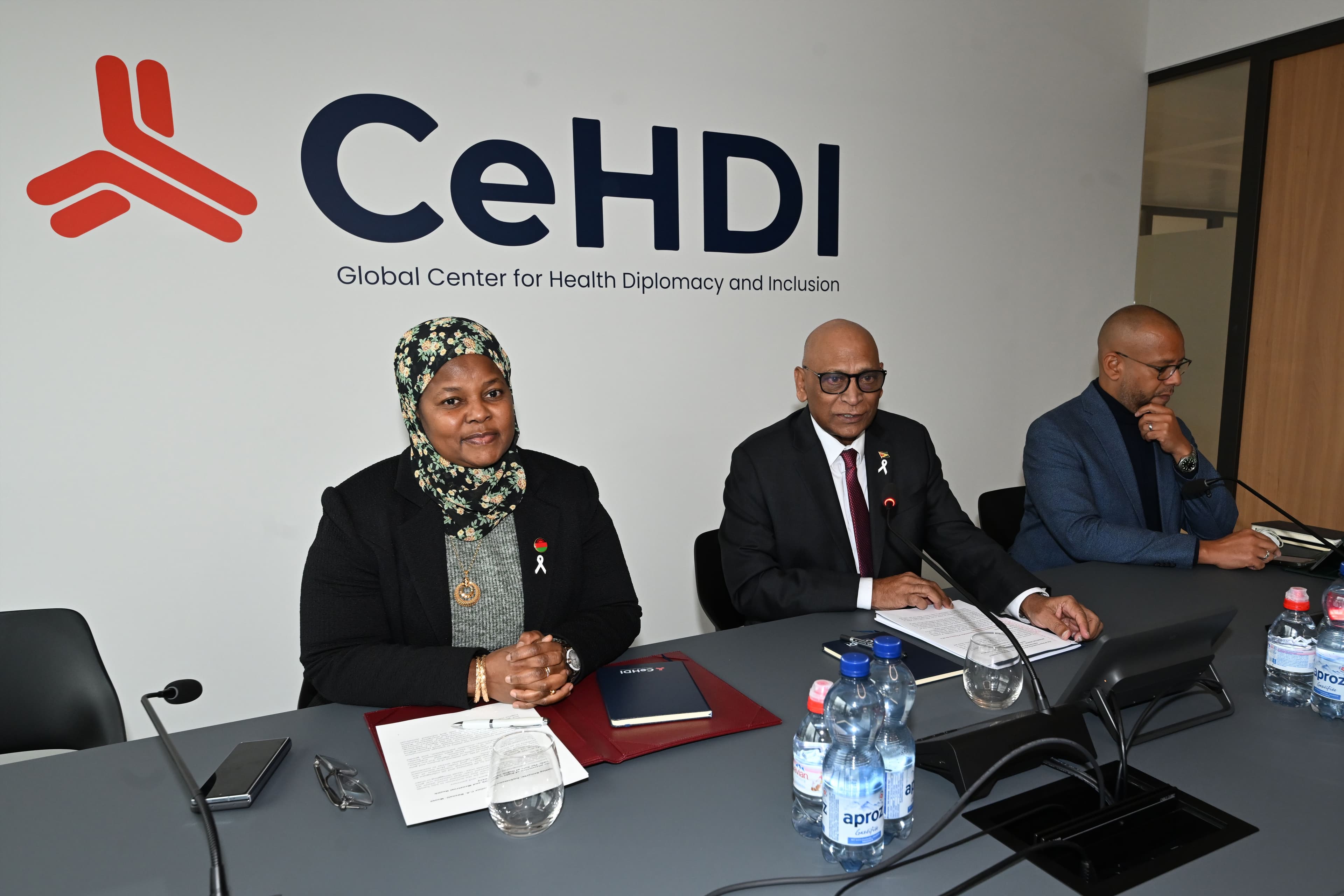
The Global Centre for Health Diplomacy and Inclusion (CeHDI) convened a high-level, interactive session co-organised by the Permanent Missions of Barbados, Malawi, and Canada, together with the Sanitation and Hygiene Fund (SHF). The hybrid session brought together ambassadors, health and trade diplomats and technical experts to discuss how to bridge health diplomacy and the right to health with global trade, taxation, and regulatory systems to shape menstrual health outcomes. Moderated by H.E. Ambassador Leslie Ramsammy of Guyana, the dialogue emphasized that menstrual health is not only a public health priority but a rights, equity, and economic justice imperative.
Menstrual health is firmly established as a human rights and development priority. The 2024 Human Rights Council Resolution 56/11 affirms menstrual health as integral to the right to health, calling for universal access to affordable products, removal of discriminatory taxes, and stronger WASH systems and education. Ensuring dignified menstruation is essential to gender equality, economic participation, and social inclusion.
Speakers emphasized that, despite recent national reforms, millions of people still cannot afford menstrual products. Taxes on raw materials often undermine exemptions on finished goods; fragile supply chains and reliance on imports keep prices unpredictable; and the lack of global product standards adds further regulatory complexity. Inaccurate customs classifications also distort trade data, limiting governments’ ability to design evidence-based policies. The meeting created a valuable opportunity to bring health diplomacy and the right to health into this discussion. Across all interventions, one message was clear, isolated tax reforms are not enough. Ensuring lasting affordability requires coordinated action across trade, customs, regulatory, and fiscal systems.
In her opening remarks, H.E. Ambassador Caroline Bwanali-Mussa of Malawi detailed the country’s 2022 tax reforms removing duty and excise taxes on pads and cups. However, she noted that consumer prices did not fall because raw-material taxes persisted, limiting local production and preventing savings from reaching women and girls. She emphasized that reforms must be coordinated across ministries of trade, finance, and health to deliver real affordability. She underscored the need for continued investment in menstrual health infrastructure and stigma-free community education, both critical to achieving Malawi’s gender and development goals. Ambassador Bwanali-Mussa shared a personal story that illustrates the urgency of the agenda. When she had her first period, she was forced to miss school for an entire week because cultural beliefs dictated that she stays home. Her mother, thinking she was protecting her, told her that she cannot leave home until she was clean, and handed her unprocessed cotton wool, something she neither understood nor felt safe using. She described feeling scared, confused, and limited in ways no girl should ever feel. It is precisely these harmful norms and barriers, she noted, that make continued stigma-free community education essential for ensuring that every girl in Malawi, Africa and beyond can manage her periods with dignity and fully pursue her education and aspirations.
H.E. Ambassador Matthew Wilson of Barbados reaffirmed his country’s continued leadership on menstrual equity, recalling the 2022 removal of VAT on all sanitary products, an action that immediately eased financial pressure on low-income households. Civil society monitoring has since confirmed reduced school absenteeism and increased access to essential products. Yet, he cautioned that the Caribbean’s heavy dependence on imported supplies leaves the region vulnerable to global price shocks and supply chain disruptions. He stressed that this is not only an economic concern but a global moral imperative: diplomacy must play a central role in safeguarding menstrual health. Ambassador Wilson urged deeper engagement with the World Trade Organisation (WTO) to ensure menstrual products are clearly classified as essential goods, distinct from non-health items such as nappies and diapers, so they receive tariff protections, benefit the women and girls who need them most, and remain affordable and safe through harmonized global quality standards.
Speaking on behalf of the Africa Group, H.E. Ambassador Ever Mlilo of Zimbabwe highlighted the continent’s high unmet need, reaching up to 75% in some countries and illustrated how inconsistent labeling rules, complex customs procedures, and misclassification of menstrual products increase import costs and delay access. Harmonizing customs rules and labeling standards, she stressed, would ease cross-border trade, reduce prices, and bolster Africa’s emerging local manufacturing sector. Such reforms would directly advance African Union’s Agenda 2063 priorities and the Continental Framework on Menstrual Health and Hygiene by improving health outcomes, reducing school absenteeism, and strengthening women’s economic participation.
Echoing this urgency, the Ambassador of Zambia H.E Ms Eunice M. Tembo Luambia expressed her strong personal passion for menstrual health, stressing that too many girls continue to miss school simply because they lack appropriate materials to manage their periods. She emphasized that decision makers must think twice before imposing taxes on menstrual products, reminding the audience that such policies directly harm girls’ education, dignity, and participation in society. She called for unwavering political will to ensure that every girl has access to safe, affordable menstrual products and never has to sacrifice her learning or well-being because of a natural biological process.
Technical experts Adrian Dongus, from Sanitation and Hygiene Fund, Michelle Tjeenk Willink of AFRIpads, and the Lisa Mallin, Canadian Mission emphasized that strategic trade reforms, most notably revising World Custom Organisation (WCO)[1] (#_ftn1) customs codes, could dramatically enhance transparency, strengthen supply chains, and drive down prices. They highlighted that menstrual products represent a growing economic sector, but systemic barriers must be dismantled for markets to function equitably and sustainably.
The Canadian Permanent Representative to WTO H.E. Nadia Theodore and Haitian Permanent Representative to the United Nations, H.E. Ann-Kathryne Lassegue were also at the meeting.
The meeting closed with a clear call to action, urging governments, multilateral institutions, and partners to work collectively to secure menstrual dignity for all. Participants were called to champion the establishment of dedicated Harmonized System codes for menstrual products at the WTO and WCO, support the global removal of taxes on menstrual products, expand free access programs for low-income communities, and sustain cross-sector collaboration to ensure that trade and public health policies reinforce and not undermine one another.
The discussion highlighted a clear reality. Menstrual Health is influenced not only by services and education but also by customs codes and tariffs. Aligning trade policy with rights-based public health approaches is a practical step toward ensuring that women and girls can manage their periods safely, affordably, and with dignity.
Session Recording - The Intersection of the Right to Health and Menstrual Health with Trade: The Role of Health Diplomacy
Article by Ambassador Ramsammy - Eliminating the “Period Tax” on Feminine Hygiene Products – A Battle For Freedom and Dignity
Article by Ambassador Matthew Wilson - The Intersection of Right to Health and Menstrual Health with Trade: The Role of Health Diplomacy
[1] (#_ftnref1) The Harmonized System (HS)—the global product classification standard used by over 212 countries and economic unions, is updated every five to six years. The World Customs Organization is now reviewing the system, with the next revision cycle set for HS 2033. There is an opportunity to submit proposals for changes, with the WCO accepting submissions until mid-2026.